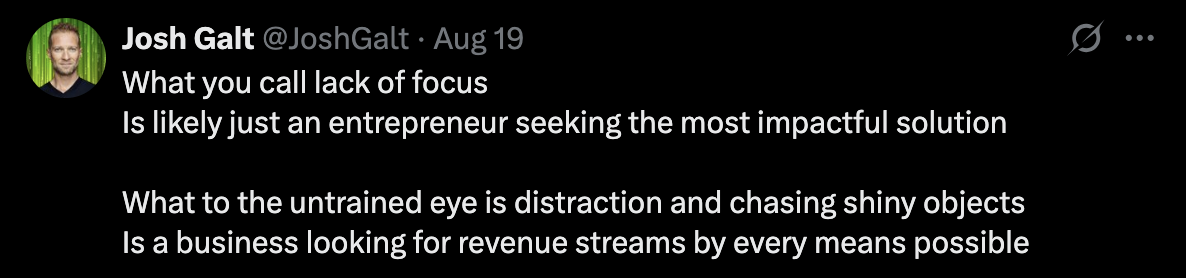

Often a startup founder will be criticized for not focusing, while simultaneously being told they should keep their job and/or get a side hustle to make ends meet before the startup takes off. The “influencer” advice online is rampant, self-righteous, and nonstop.
These are comments usually from outside the arena, but not always – often it’s from advisors or investors who want to see “more skin in the game” and “more traction” before taking the risk with their capital.
While likely well-meaning, unless one has walked in the entrepreneurs shoes -and in this half-decade, not some decade far in the past- they’re unlikely to have even the slightest inkling of the absurdity of the suggestion to get a side-hustle outside the business to pay their bills…but will still say the founder absolutely shouldn’t attempt to create a slightly different revenue stream within the business as that’s being “distracted”.
The reality is instead of getting an outside job or unrelated hustle, entrepreneurs should be encouraged to innovate within the company in every way possible at the outset, especially prior to receiving VC funding which starts the clock ticking on exponential growth, and subsequently allows for much more strategic and single-minded focus.
Any investor who tells you anything different, is out of touch with the world today where us mortals dwell on the ground, and that can happen after too many years of floating on the deified strata at the atmospheric union of dos y viente (while batting .200 at best).
They mean well, but also, put up or shut up – their bank wire gets my complete focus, but their armchair quarterbacking is both unhelpful and whatever the opposite of endearing is.
(If that statement seems overly harsh or offensive, perhaps ask yourself why you’re triggered? Honestly, an investor’s opinion shouldn’t actually matter to any founder unless THEY have skin in YOUR game, so it’s perfectly reasonable to set boundaries.)
Startups have a 1 in 10 chance of surviving the first year. If you have to do side quests, there’s no shame in that – but find ways to do them related to the core business. That’s often where the real brilliant innovations and synergistic partnerships are found anyway, at the melding of core capacity with loosely related yet distinctly connected projects.
I see so much talk about “pivots” when a full pivot is probably not necessary, at least in the early stages. If the principle idea was good enough to dedicate yourself to making it a startup, and if it was unique enough to attract investor attention -if not also tangible angel or seed capital- then it’s unlikely that prior to receiving significant funding you would need to fully pivot.
What you probably need instead is that “lack of focus” in a purposefully structured way!
Create a mind map, or a spreadsheet, or ask your AI BFF for advice, but uncover every potential idea you as a founder can bring to the table that might add value to your company to keep you going right now, and then -and this is key- connect it to your core business.
That’s where the magic happens, and these seemingly disparate ideas have to be connected in a way that not only makes sense, but creates synergy.
Do that more than once, do it 5, 10 times. And ship it. Create those revenue streams, no matter how small, ensuring that they are unquestionably connected to your base-level startup.
This sounds a lot easier than it is to do, not because you’ll struggle to make those connections or find synergistic additions to your business, but because you will get significant pushback and even criticism from investors, advisors, and even within your inner circle.
Less flexible or visionary members of your own team will likely balk at this strategic decision, but if they’re not paying all the bills, find a way to sell them on why it’s valuable and get them on board, even if only begrudgingly. For the outsiders, ignore them.
Seriously – because you should only take advice from someone who is at the level you want to get to, and if you know any of those people personally, they’re either going to back your startup financially or tell you the hard truth that your plan utterly sucks, but either way they’re not likely to hide behind the excuse of you, the under-capitalized founder, being “unfocused…so come back with hat in hand when you get on the straight and narrow”.
Because if they’re at the level you want to attain, and they started out bootstrapping, then they’re likely going to understand where you’re at and why you need to diversify within the company’s product offerings until one of those channels finally grows wings.
Product-market fit doesn’t happen in a vacuum it is found through experimentation! Hello.
You have to throw things at the wall and see what sticks. Ideally as inexpensively as possible, but how else are you going to truly discover what the market wants and will pay for?
Of course you also might not know if those giving you advice actually have been in your shoes because survivorship bias is a very real and very contagious societal disease, and I say that as a big fan of and believer in the Horatio Alger character.
We can all recite stories of the myriad founders who “started in their garage” but naively ignore the significant capital that they started with thanks to mommy daddy or other wealthy benefactor.
That’s not to diminish what any of them went on to build, at all (except for Bill Gates, to hell with that anti-human maniac) – simply to make the point that they didn’t bootstrap from nothing with a side job or existing external bills to pay which the company didn’t make enough to cover in the early days, so they’re not going to understand why you are looking at any and every potential revenue pathway possible for your startup.
Obviously, if the extras you’re doing are in no way related to your core business that’s probably not ideal, unless it pays really well and you can completely disconnect from it for several hours daily to work on your startup.
But if the side quests are relevant, you’ll be surprised how many “unrelated” doors open and turn out to be both inspired ideas and clear opportunities you hadn’t previously thought of for your main pursuit.
It’s almost as though the universe rewards action in a positive direction.
And perhaps that’s also why nearly everyone in your life will push for you not to take it, leveling various charged accusations at you – in this cosmic test of human simulation, if you are inherently driven and externally challenged, criticism is part of the design – make it your mission to keep pushing through.
You’re playing life on difficult mode because your task is to level up, in every way.
So do that, no matter how far-fetched your ideas seem, because at the end of the day, you are the only one who knows your vision, and you are the only one who truly cares about your success.
Ayn Rand was right – selfishness is a virtue. Because if you don’t fully believe in yourself, enough to put your confidence in your ideas and build your startup the way you believe is most likely to bring it success…then who will?
Nobody else will. It’s up to you. So turn that “distraction” into multiple foundational pillars for your platform, in the unique way only you can do.
Believe in what you’re doing enough to sell it, ship it, to find your tribe for each iteration, and you’re going to see more doors open than you can possibly believe.
But each new breakthrough, opportunity, relationship, or open door will bring new voices planting seeds of doubt – so invest in the best pair of metaphorical earplugs you can afford!
YOU’RE THE FOUNDER, YOUR STARTUP LIVES OR DIES BECAUSE OF YOU. Believe in yourself and either win or go out in a blaze of glory. But do not change course because of the opinions of outsiders.